
The Obesity Action Coalition

How can the primary care experience be redesigned to eliminate weight bias?
Client
The Obesity Action Coalition (OAC)
Project
Patient Centered Healthcare for People With Obesity
People with obesity face discrimination in many areas of life, but perhaps the most deadly form of discrimination is weight bias from their healthcare providers. It often causes physicians to believe that every medical problem a patient is experiencing is the result of their obesity—leading them to overlook other, solvable issues. This leads to poor physical and psychological outcomes and further marginalizes people with obesity in society.
Thoughtform partnered with the Obesity Action Coalition and ConscienHealth to design an improved patient care experience for people with obesity. The goal of the project is to open the eyes of doctors and the media to shorter-term and longer-term ways doctors can create a more welcoming and satisfying experience for people with obesity.
An Advocacy Nonprofit
The Obesity Action Coalition (OAC) is dedicated to giving a voice to the millions of Americans affected by the disease of obesity and empowering along their journey toward better health.
The OAC and ConscienHealth, a nonprofit organization dedicated to helping experts and advocates educate the public and provide a voice for people with obesity, worked with Thoughtform to uncover the needs and desires of people with obesity and design a service model for an improved primary care experience.
Listen to the conversation on our podcast >
Making people with obesity the experts in their care
The key to understanding what people with obesity truly need out of their healthcare experience is to go directly to the source.
Using our co-design methodology, we put together a listening group of people with obesity to do a deep dive into their experiences with primary care, the kinds of discrimination they’ve faced, what changes in the experience could help to improve their faith in the healthcare system and make them more likely to engage in positive health behaviors.
An illustrated patient experience story
Based on the insights from the co-design sessions, the Thoughtform team designed a prototype of an illustrated end-to-end patient experience story that puts people with obesity at the center of their own care and doesn’t put undue strain on the providers.

Research-backed design validation
We validated this redesigned experience with a survey set of 250 adults with obesity to ensure that the elements of the care experience prioritized were generalizable across the broader population.
Thoughtform worked collaboratively with researchers from Drexel University and the American Board of Obesity Medicine Foundation to design a survey that gauges what is most important to people with obesity in primary care.
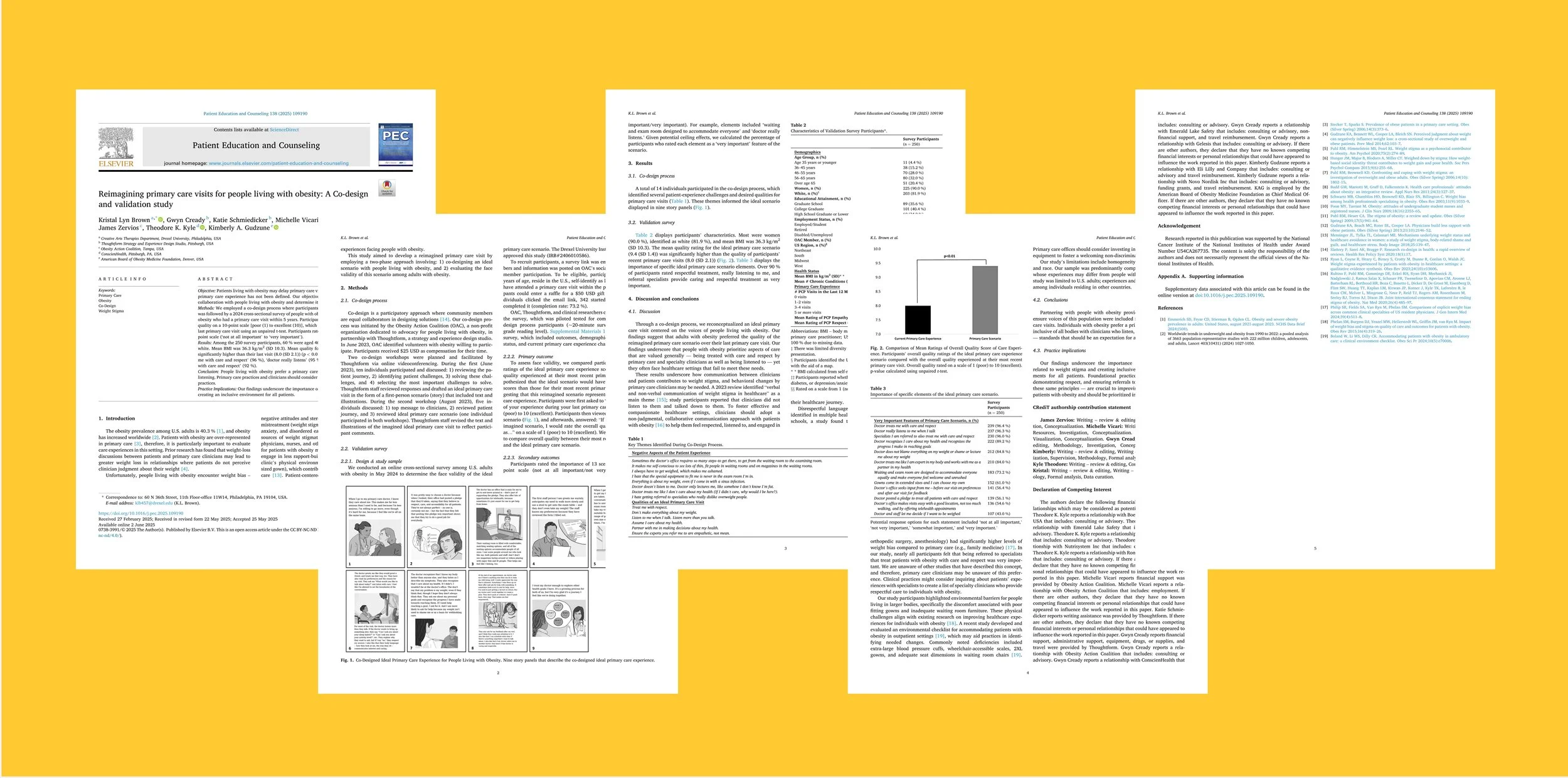
We presented the results of this work at the Obesity Week annual conference and published the findings in Patient Education and Counseling.
How will this change the world?
The results of the study showed that the most important aspects of a primary care experience for people with obesity are that doctors and specialists treat them with care and respect.
Beyond that, people with obesity want to be recognized as making progress toward their goals, don’t want doctors to blame everything on their weight, and want to be treated like an expert on their own body and a partner in their health.
The research findings underscore the importance of educating clinicians on how weight bias occurs, why it is harmful, and how to combat it both within their practice and within themselves.
Just a few key foundational practices—active listening, demonstrating respect, and only referring to clinicians who demonstrate respect—can have a great impact on patient experience for those with obesity and should be prioritized.