
Caterpillar Connect

Can a modern design process transform a sales culture?
Client
Caterpillar
Project
Transforming a global sales culture
Caterpillar® and Cat® dealers use data from technology-equipped machines to provide more insights into customers’ equipment and operations. Cat Connect, the commercial offering for digital services, gives customers visibility into the performance of their fleets and businesses, as well as empowers them to make smart decisions.
But, dealer sales teams were used to selling iron. Cat Connect requires them to understand customers’ needs, recommend solutions, and prove ROI—a process they haven’t done before.
ThoughtForm created a two-day instructor-led training course with clear language, visual explanations, and interactive adult learning techniques to help Caterpillar teach dealer salespeople how to use a consultative selling approach with customers. In deploying the course, Caterpillar brings consistency and accountability to the way Cat Connect is sold around the world.
Who did we help?
Caterpillar Inc. is the world’s leading manufacturer of construction and mining equipment, diesel and natural gas engines, industrial gas turbines, and diesel-electric locomotives. The Cat brand is the cornerstone of the Caterpillar portfolio, representing products and services for customers working in Construction, Resource, and Energy & Transportation industries. Caterpillar relies on a distribution network of more than 220 Cat dealers in over 180 countries.
Caterpillar is headquartered in Peoria, Illinois, and has regionally-based teams (Distribution Services Divisions) that work directly with Cat dealers to implement corporate strategies that help them improve their operations and grow their businesses.
Using Foglifters to make sense
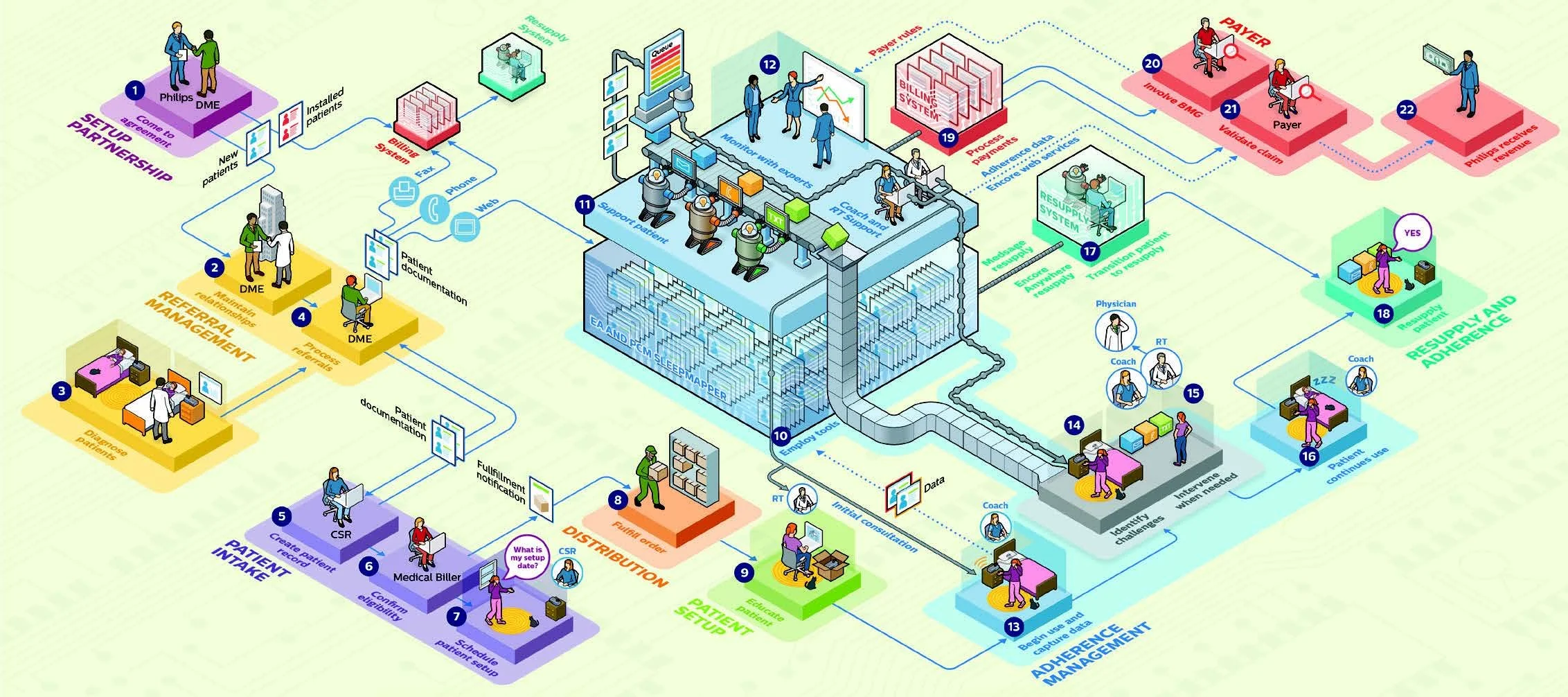
To provide the team with a comprehensive overview of the new service offering, we led the Philips team through a collaborative design process, ultimately developing a Foglifter visual explanation to enable stakeholders to quickly and easily understand the gist of the strategy then dive into additional detail if needed.

Captured the initiative team’s vision for the new product strategy and service design.
ThoughtForm met with the Philips team and used visual thinking facilitation techniques to understand the essential criteria and system pieces of the new business model. Creating a series of napkin sketch drafts of the visual model allowed the project team to explore different storytelling structures and refine key messages. Along the way, ThoughtForm helped Philips refine their overall approach to the service offering and begin to define details of the implementation.

Developed a refined Foglifter® to build alignment and gain leadership buy-in.
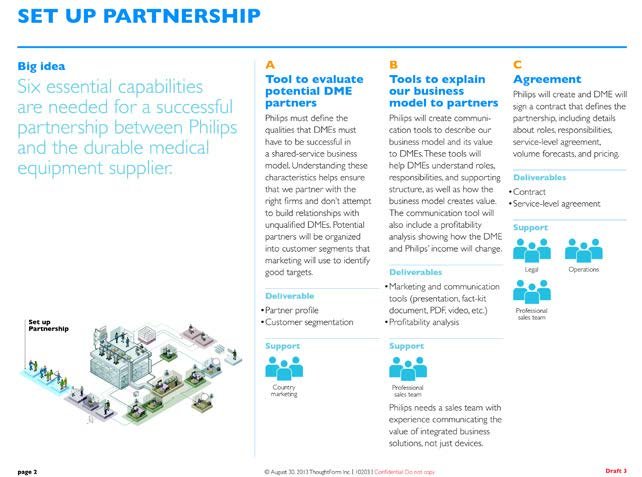
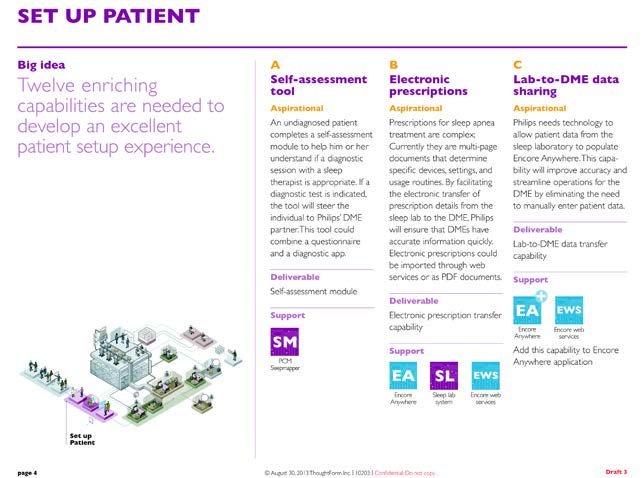
ThoughtForm refined the design drawings and napkin sketches to develop a FogLifter. This visual explanation was used broadly with leadership and implementation teams in both 11” x 17” placemat and presentation formats. The Foglifter’s visual storytelling helped stakeholders quickly understand the project team’s approach, how the new business model differed from the existing model, and the advantages of the strategy. The Foglifter was supplemented by Deep Dives, which provided additional details necessary for implementation.

Packaged the course as a complete kit.
Once leadership approved the new vision and the implementation team defined an approach to move forward, it was time to prepare the organization for the shift. ThoughtForm created experience maps and implementation plan timelines to ensure alignment and realistic expectations for internal teams in IT, operations, customer service, and products, as well as external stakeholders such as distributors and physicians.
The Impact
The combination of a Foglifter with polished visuals and descriptions, deep dives into all of the implementation details, and experience maps and implementation plan to ensure alignment gave Philips Health the power to:
Increase speed to market by using prototypes to work through service design kinks.
Secure leadership buy-in and approval, resulting in continuous initiative funding.
Launch a new service offering that improved user experience and lowered costs.
Foster internal alignment and a company culture of innovation.