
Turning healthcare data into impact
We all want healthcare decision-making to be data-driven. We want our providers to know what treatments are the most evidence-based. We want our insurance companies to cover the treatments that will be most effective for as long as they’re needed. We want medical device makers to stay on the cutting edge of medicine.
And in this, there is some good news: life sciences organizations are great at generating real-world data—data on patient health and care delivery collected from electronic health records, medical claims, disease registries, medical devices, and more—also known as RWD. In recent years, many of these organizations have invested heavily in their data gathering and research capabilities to make sure they have access to a wealth of data on patients, payers, procedures, and more.
But there remains a gap.
Despite this wealth of data and evidence, very few life sciences organizations have been able to translate RWD into real world impact. The data is not improving patient outcomes. The evidence is not improving payer decision-making.
It’s not because organizations are just ignoring the data. They’ve spent countless resources on transforming their operations to gather as much data as they can so they can make the best decisions possible.
So then, what is it?
This is the question we answer in our new paper, co-authored by Thoughtform and a team of researchers at Duke University, titled “Building The Execution Architecture For Real-World Data To Have Real-World Impact,” published in Clinical Leader.
And the answer is, of course, a lack of good design.
Getting the point across
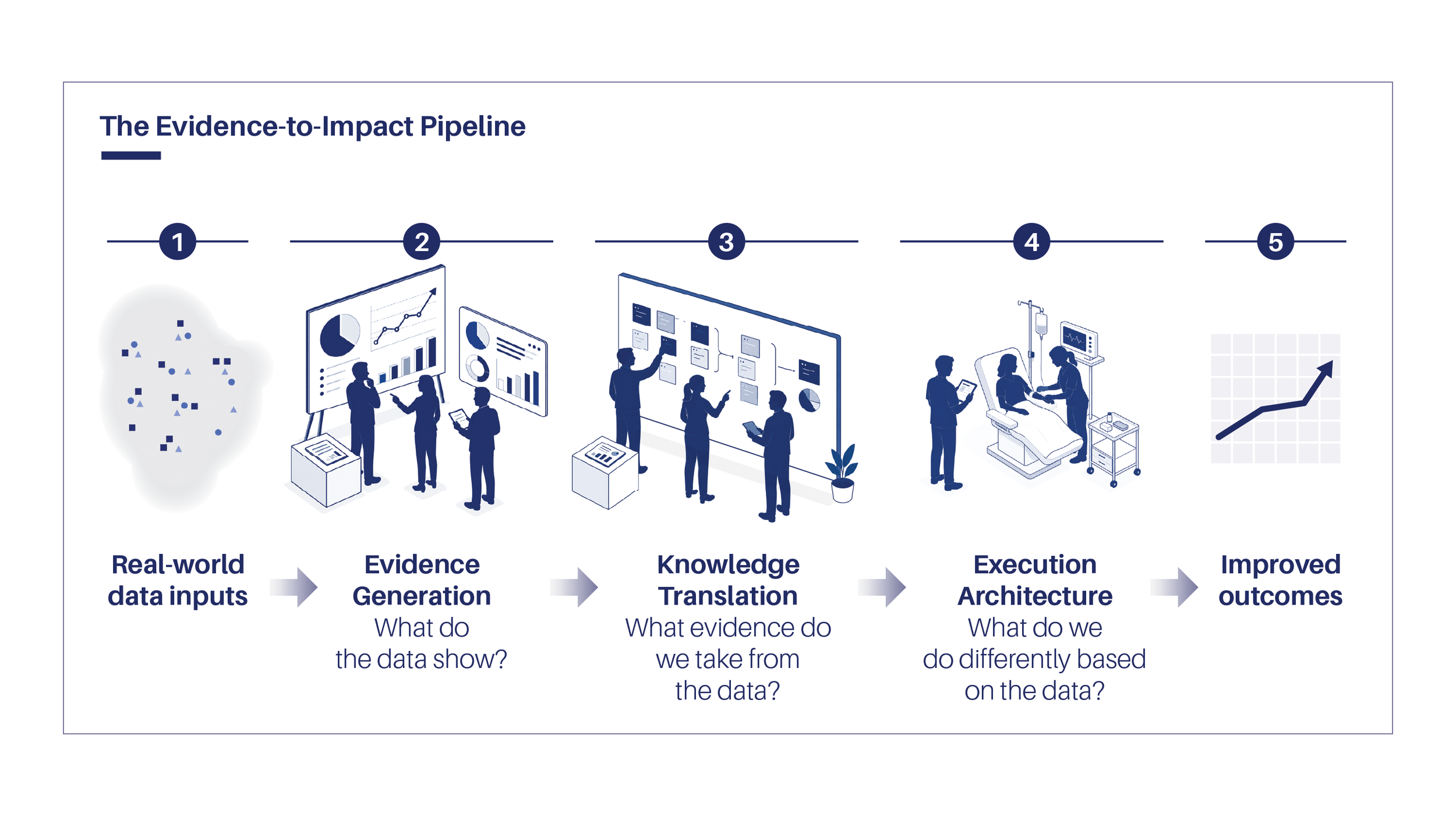
With so much focus and investment on generating RWD, very few organizations have been able to realize the assumed returns on this investment. We identify two critical failure points:
Evidence generation: organizations lack the ability to transform RWD into scientifically defensible evidence, known as real-world evidence (RWE).
Execution architecture: organizations don’t have the infrastructure necessary to translate evidence into decisions, workflows, and sustained implementation.
And while these may appear as distinct problems, they can both be traced back to a common link: knowledge translation.
“RWE often fails to translate consistently into decisions, behavior change, and sustained impact,” the paper explains. “High-quality analyses may be produced, but their influence on organizational decision-making, and ultimately on prescribing, adherence, payer positioning, and care delivery, remains uneven.”
We define knowledge translation as the necessary link between evidence generation and execution. In other words: What evidence can we take from the data, and what will we do differently because of it?
The problem is, most organizations don’t have the RWE maturity necessary—and therefore the organizational infrastructure—to turn this evidence into action.
The path to RWE maturity
RWE maturity can be understood as a progression through three stages:
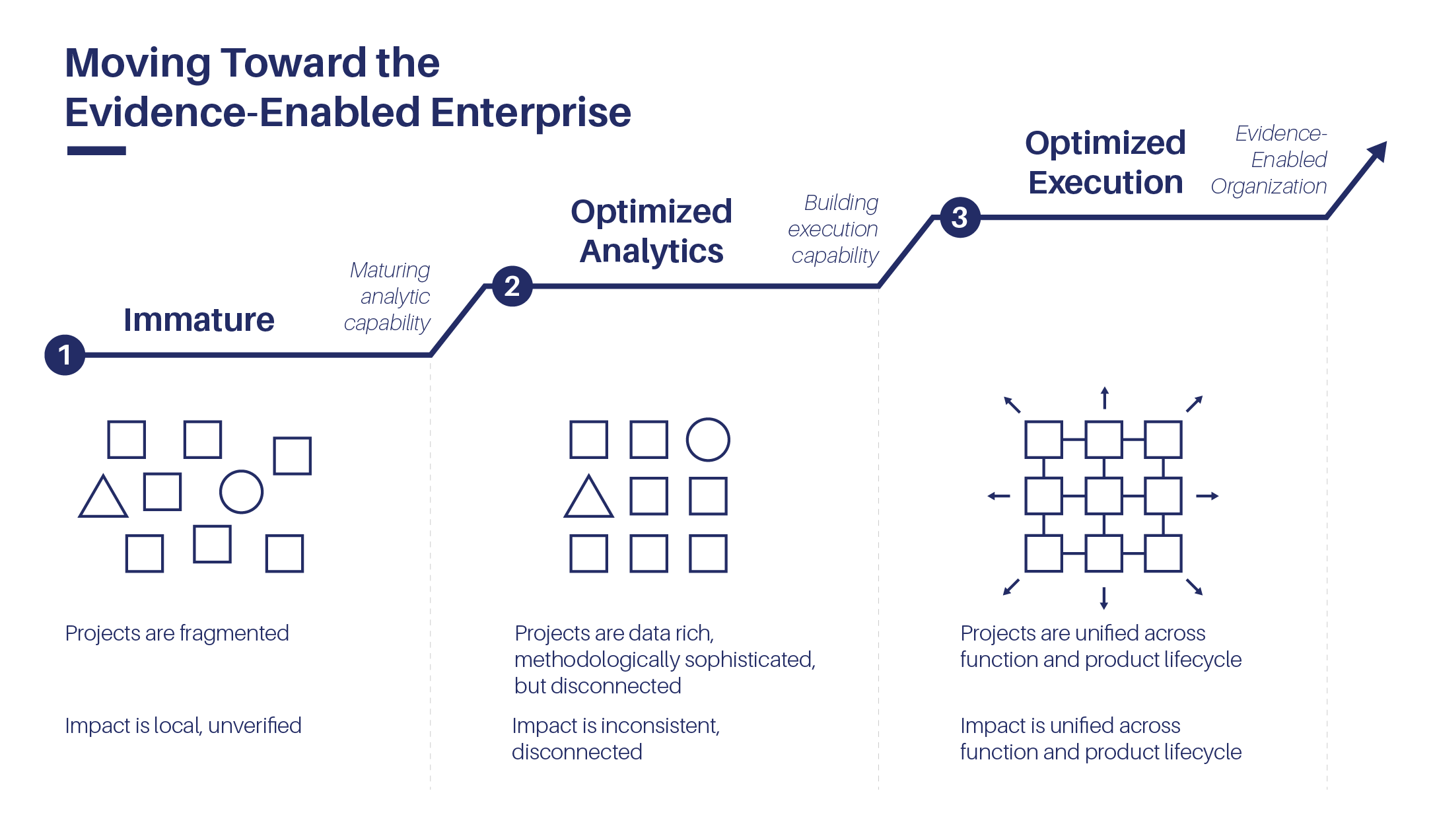
In the paper, we argue that knowledge translation breaks down because organizations don’t have a well-defined, well-designed execution architecture. This architecture includes “governance structures that define decision rights, workflows to integrate evidence into routine practice, behavioral design elements that influence action, and incentive systems that reinforce desired behaviors.”
The execution architecture is an essential part of ensuring organizations actually use the data they collect. In most ordinary situations, individuals desire to make the best possible decisions. But when an individual is part of a complex system, they are much more likely to default to “standard practices,” rather than changing their behavior based on new information.
The purpose of the execution architecture is to turn behavior change into standard practice, so that organizations can continually incentivize individuals to understand and implement the implications of the data they’re gathering.
How you do that, however, is a design challenge that requires buy-in and enthusiasm from people across the organization who see and understand the value.
To read the full explanation of our solution and see how a sophisticated Evidence-to-Impact Pathway can bring an organization to the final stage of RWE maturity—not to mention how GLP-1 therapies are a prime example of what we’re talking about—read the full paper in Clinical Leader.